Exhibitions
Living collections
Tuesday to Friday from 10am to 5:30pm, Saturday and Sunday from 10am to 7pm.
Tuesday to Friday from 10am to 5:30pm, Saturday and Sunday from 10am to 7pm.
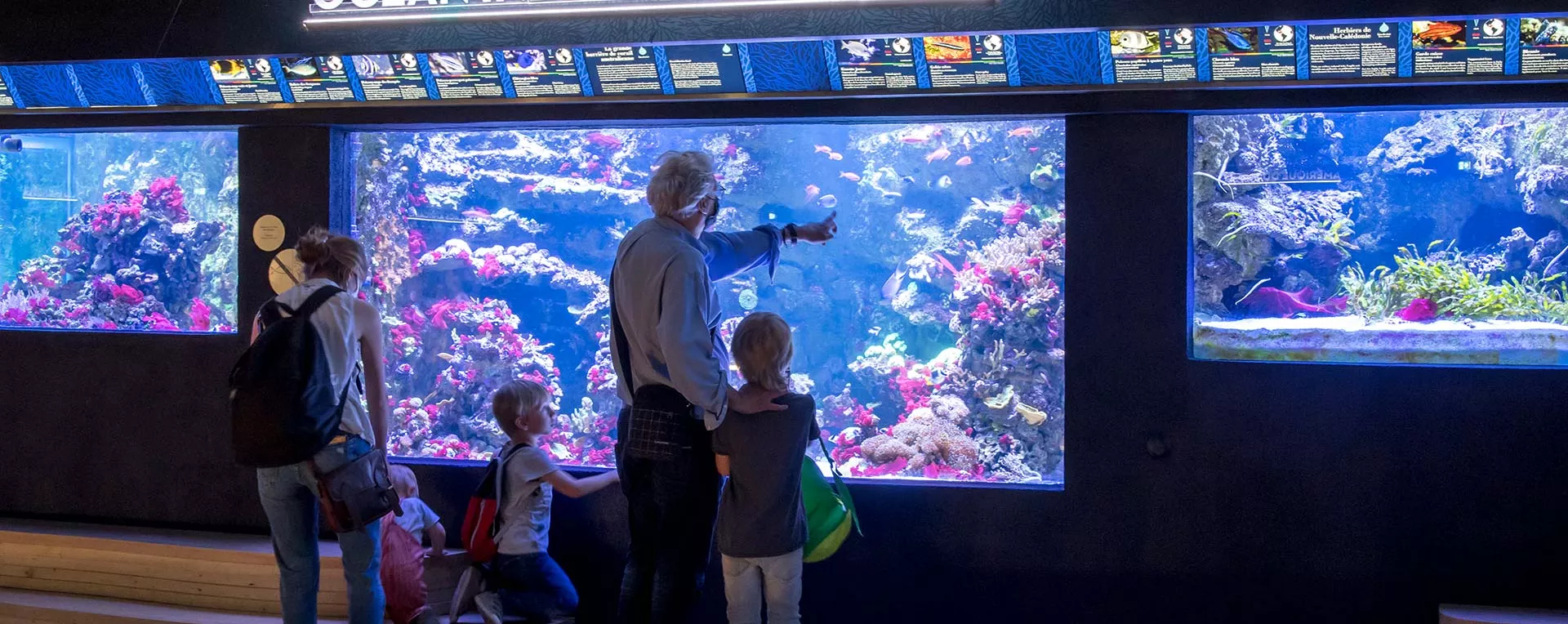
Discover the Tropical Aquarium at the Palais de la Porte Dorée: from mountain streams to coral reefs, from the Great Lakes of Africa to the wetlands of Asia and the Americas, set off on a journey through tropical oceanic and continental waters… right on the doorstep of Paris!
In an nearly century-old aquarium, explore a fascinating world: dive into the heart of coral reefs, travel down the rivers of the Amazon and Asia, discover the depths of Africa’s Great Lakes and the caves of Central America, and venture through the mangrove, that unique ecosystem where land meets sea.
Throughout your journey, encounter an incredible diversity of tropical aquatic flora and fauna. Turtles, seahorses, rays, alligators, electric fish, clownfish and surgeonfish are just some of the iconic species that will fill you with wonder. And that’s just a glimpse: many more inhabitants of tropical waters await you there!

Aquarium tropical. Photo Anne Volery
With its 85 tanks, around 4,000 animals and 350 species, the Aquarium showcases tropical aquatic ecosystems and the species that inhabit them. Presented as living tableaux, these freshwater and saltwater tanks, along with the terrariums, recreate natural habitats as faithfully as possible. The animal and plant species on display are representative of, and in some cases endemic to, these habitats.
Did you know? The seawater is produced on site – in fact, the Tropical Aquarium is Paris’s leading producer of seawater!
The star of the Tropical Aquarium is full of surprises!
Some surprising facts:

Poisson clown
Photo : Déodat Manchon © Palais de la Porte Dorée
The name ‘dipneust’ comes from Greek and means ‘two lungs’. This name suits it particularly well: although it has gills, the dipneust actually breathes using lungs. It therefore regularly surfaces to take a breath of air.
With its lungs and fleshy fins – which are like small legs and remind us of the limbs of the first animals to leave the water – the dipneust occupies a unique place in evolution. It is one of the fish most closely related to the ancestors of terrestrial vertebrates, the group to which humans, in particular, belong.

Dipneuste australien - Neoceratodus forsteri
Photo : Déodat Manchon © Palais de la Porte Dorée
Contrary to appearances, coral is an animal. It lives in symbiosis with microalgae, known as zooxanthellae, which it harbours within its own organic tissues. These tiny algae are essential to it, as they produce nearly 70% of its food. But when the water becomes too warm, acidic or polluted, the coral expels them: its colours change, it turns white, and then dies within a few weeks.
Today, coral reefs are seriously threatened by climate change, despite being home to exceptional biodiversity. The Tropical Aquarium displays several species of coral and, since 2009, has been collaborating with the Musée nationale d'Histoire naturelle to conduct research dedicated to their conservation.

As the sole representative of its genus, it possesses characteristics that make it unmistakable. It is the only turtle with a prominent snout, a striking feature which, incidentally, gave it its name. Its snout is adapted for searching for prey in the mud.
Its carapace, covered in a thin layer of skin, is uniformly grey to blackish-brown on the upper side and covered by a pale plastron on the underside. Its limbs resemble those of sea turtles, which are better adapted to swimming. It is exclusively aquatic, living in rivers but occasionally venturing into the sea. Its omnivorous diet consists of fish, shellfish, snails and fruit.

Tortue à nez de cochon - Carretochelys insculpta
Alligators live in the fresh or slightly brackish waters of swamps and estuaries, such as the famous Louisiana bayous, a network of former branches of the River Mississippi. They came very close to becoming extinct. However, thanks to a conservation and reintroduction programme launched in the 1960s, more than a million alligators now inhabit the coasts of Florida and Louisiana.

Alligator du Mississippi - Alligator mississippiensis
Photo : Déodat Manchon © Palais de la Porte Dorée
In Malagasy, its name, Joba Mena, means ‘red girl’. There are significant differences between the male and the female. The female, which is mainly grey in colour, is smaller than the male, who is also more colourful, with the tips of his fins turning red. The ‘red girl’ is actually a male! A male can breed with several females. Once the eggs have been laid and fertilised, the female alone looks after the nest and the young for several days.
Ptychochromis insolitus is found exclusively in the watercourses of the Sofia River basin, such as the Amboaboa River. It inhabits shallow, fast-flowing rivers where the water is clear. When it needs shelter, it prefers deeper pools consisting of sand and rocky sediments.

Joba Mena « Ptychochromis insolitus » mâle nageant au-dessus de deux femelles.
Photo : Frederic Fasquel © Palais de la Porte Dorée
From coral reefs to the marshes of French Guyana, via the Western Ghâts of India and the rivers of Madagascar, explore the major tropical aquatic ecosystems. The exhibition panels reveal their riches and the challenges involved in their conservation. Continue your exploration on our website.
As you explore the aquarium, discover the Rivage area: a place to slow down, experience the aquatic world from a different perspective, and explore further.
Designed for families, it brings together three complementary areas:
Through an immersive film, set off to explore the Coral Triangle alongside the Tara Coral expedition teams. From dives on the reefs to samples taken at sea, experience the daily lives of the researchers working to better understand corals and their astonishing ability to adapt to climate change.

Fosse de l'Aquarium
Photo : Anne Volery © Palais de la Porte Dorée
The Aquarium’s roles are vast and diverse, and extend far beyond what visitors can see.
The Tropical Aquarium partners with and actively participates in programmes to protect endangered species, both in its tanks and in the field.
Committed to the conservation of threatened species, particularly freshwater species, the Tropical Aquarium highlights the extreme fragility of these often little-known habitats, which are nonetheless just as threatened, notably by pollution, overexploitation, habitat degradation and the introduction of invasive species. Lakes and rivers account for just 1 per cent of the Earth’s surface, yet they are home to 12 per cent of all animal and plant species.